This Blog focuses on the impact being neurodivergent has had on my family life. My dated soundtrack formed a method to reflect on life milestones. It charts a course from my being dependent on parents, strugling to cope with my differences. To my becoming independent and making my own mistakes. Then becoming a carer and working to reconcile myself with the decisions both my parents and I had taken.
My relationship with music is mixed. I have never been able to sleep without the radio playing. When I was eight, I was sent to boarding school. I would still go to sleep listening to radio Luxemburg. It would sometimes get me into trouble.
School made me embarrassed by my taste for glam and country. It trod heavily on most of the things I cherished and was interested in. Teachers drummed my passions out of me. Focusing on what I could not do, reading and writing was what mattered. I was told I was tone deaf and I would never achieve my ambition to be a DJ. Educators did not see it as being part of their job to make pupils feel confident, in the 70s. I became addicted to Radio 4 and ended up a news junky. Which was probably how I ended up passing my economics degree. Economics became a lifelong fascination.
While I was a Carer, for respite, I started going to gigs. It worked. Moving my body in a Dyspraxic frenzy, while immersing myself in sound and lyrics gave me relief from the stress of looking after an agitated mother, in decline.
This Play List is a series of meditations. The first four tracks mostly relate to my time at school. The second batch my adult life. My reflections frequently turned out to be double edged.
The Universal Music Creative Difference report(Universal Music , 2020) noted how many people working in the music industry are neurodivergent (ND) . I have not chosen ND artists but by coincidence some of the artists on my playlist are ND or ND advocates.
2. Three Little Birds – Bob Marley and the Wailers – 1977
“Don’t worry about a thing,
Cause everything, is gonna be alright”
Key Statistic – 86% of parents of autistic children face blame when asking for help from health, education, and social care services. Some systems even misattribute a child’s sensory overload or school attendance distress as the parents’ fault.(Sinead L Mullaly, 2025)
Three little birds, speaks about hope in the face of adversity.
While I wish my parents had woried less about my neuro differences. I can understand why they felt anxious.
My parents had to cope with parent blaming in the 60s and 70s. It is a shocking injustice that our public institutions continue to blame parents for asking for help.
My mum was concerned I was missing child development milestones. The District Nurse told her not to worry. She was “ just an anxious parent”. She was right to be concerned. I was always falling over; I had difficulty talking and would not be able to read until I was 11. (Even now I am a reluctant reader)
Both of my parents were scared when my primary school invited them in and told them they could not teach me. They were, shocked when the school, recommended I attend a remedial centre. The shock turned to horror as I became progressively more angry and emotionally disturbed. I don’t think they knew what to do when I was sent to a behavioural unit.
The plethora of professionals who were supposed to assist were a mixed blessing. Those employed by the Local Education Authority, denied the existence of dyslexia. It was cheaper that way. Much easier to say all the problems were down to the parents.
Some of the private professionals started to talk about dyslexia, (My traits were not consistent with the 1970s understanding of autism. (If a time machine existed I might have received a 2010s autism diagnosis.) One professional talked about minimum cerebral palsy (Kirby A. , 2020) (It was later explained that this was not an uncommon 1960s diagnosis for what is now known as DCS or Dyspraxia.) All these medical conditions carried stigma. Fears that brain damage during birth, which was sometimes associated with cerebral palsy, had been the cause, added to my mother’s sense of guilt and fear.
Other professionals fed off my parents concern. They recommended a range of paid for services, included tutoring and specialist schools. None of the schools were local, so they opted to send me to a specialist boarding school a hundred miles from home.
For a long time, this decision damaged my relationship with my parents. I felt rejected. being sent away made me more agitated and less secure. I was aware of not meeting my parents’ expectations.
My parent’s view was everything turned out alright. My view is it would have been alright anyway. The same outcome could have been achieved at less cost to both family relationships and finances, if the advice and support, my parents received from professionals, had been better.
Much of my education was focused on trying to make me academic. To a degree, I suceeded as a student. However school crushed many of my childhood interests. As a child I enjoyed making things and finding out how they worked. I was interesting in gardening and loved animals. I loved music. All of which could have opened career oppertunities but the focus on academia, was at the expence of my practicle skills and interests.
Academia was however all my parents understood. They believed that a good education and a good degree was the passport to middle class sucess. They did not see the world was changing and that a degree in the 1980s would not guarentee a good job.
3. Schools Out – Alice Cooper, 1972
“School’s out for summer,
Schools out forever”
Key Statistics
- Autistic children are 46 times more likely to experience school distress than their neurotypical counterparts.
- 92.1% of children with school attendance problems were neurodivergent. (Mullally, 2024)
1972- 74 was when I was most angry. While I was scared, of Alice Cooper. Schools Out was my anthem. It was too dangerous to buy. Earnie the fastest milkman in the west was, much safer, to share with my parents.
I hated the remedial centre which I had to attend. My parents were at the end of their tether and had given up on the LEA. I was about to be sent to a boarding school, but for the summer of 72, school was out.
I was not prepared for boarding school life. Being teased about things I cared about. Not being able to sleep, being frightened, and not being allowed to talk to anyone. Fellow pupils who pretended to be friends and then set you up as a laughingstock. Being attacked on the staircase and having plasticene smothered into my hair.
My anger led me to rampage around the ground brandishing a large stick. Half the school were behind me goading me on. My enemy with the plasticene formed a rival army. I was too afraid of pain to enter war, but teachers rarely intervened.
Every few weeks I returned home for a weekend. The night before going back to school, I would not sleep. The only thing that would comfort me was my mother’s beagle. I refused to get in the car when my dad wanted to take me to school. When I got to school I locked myself in the car, on one occasion I kicked the headmaster and told him what I thought of his school. After a year and half my parents moved me to a better school.
After I changed school, my life improved. I had fewer meltdowns but always felt vulnerable to bullies both pupils and teachers. I miss trusted the cool kids, who cared about image and appearance, but would turn on anyone who was different. I all too often hit out against pupils and teachers, who I perceived to be undermining me.
I could not work out when fitting in was the right thing to do, or when it was right to hold firm to my own values. I was too easily influenced by what I perceived to be the in crowd and ended up doing and saying much I now regret. I struggled to find my own identity, build confidence and self-esteem.
During this period, although I was disturbed, some teachers were remarkably understanding, tolerant, and kind. Even after I had kicked them.
At the remedial centre, a maths teacher, Mrs Mann extraordinarily perceived I might be quite good at maths. She gave me extra lessons. She started to teach me equations. I don’t think it clicked at the time, but it opened a door which became important later.
At my first boarding school, when I had a meltdown or couldn’t sleep, the husband of the bursar a retired colonel would play chess with me. Allowing my anger to subside.
Later, at my secondary school, after I got a U (unclassified) grade in my English ‘O’ Level (I had written a terrible essay about assassinating Mrs Thatcher, inspired by reading the day of the Jackal ) The head of English gave me one to one tuition. After advice, I changed exam board. The London board offered multiple choice, comprehension tests. I got lucky with my essay, I wrote about the right and wrongs of private education. I scraped a pass.
4. San Quentin – Johnny Cash 1969
“San Quentin, you have been living hell to me.”
--------------
“And may the world regret you did no good.”
Key Statistics
For every 1 000 children with Neurodevelopmental conditions which are not identified early
- 150-200 - Will experience school exclusion or repeated suspension.
- 300- Will experience a period Not in Education Employment or Training (NEET)
- 100-150 - Will have contact with the justice system
The life cycle cost of supporting each NEET person is on average £120 000
The Cost of each Justice intervention is on average £60 000 - £70 000
Other costs include additional health interventions, loss of tax revenue, and lost productivity. (Kirby, 2026)
Johnny Cash, famously, recorded a live concert in the dining area within San Quentin prison. His passion, resonated, while I was at school because disliked of boarding.
Thinking back, my anger relates to the Local Education Authority. They made my, and my family’s life a living hell. I hate the way that in the 70s they denied the existence of my dyslexia. I am furious that so many politicians, still cynically try to deny the existence of neurodivergent conditions. I am enraged that the only way families can get the support they need for an ND learner is to take the Local Authority to a tribunal. And I am maddened that many of the pupils who most need help cannot afford the lawyers needed to make a successful appeal.
I am appalled, when I recall the Headmaster at the remedial centre I attended beating his cane against a desk, saying most of us pupils, would end up in jail. One pupil had been caught shop lifting. I am disgusted when I read nearly 60 years on, that the neurodiversity school to prison pipeline continues unchecked. I don’t understand why we as a society, won’t invest in providing support which give ND people a better chance to live more purposeful and happier lives.
I am troubled when I think of my fellow remedial school pupils. Many were at least as talented as me. I fear many were not given the opportunities my parents money bought. I was saddened when a career advisor told me, she considered a zero hours, minimum wage, self-stacking job was a good outcome for an autistic graduate with a master’s degree in software design. I was proud, when am Autistic Student Journalist told me that when his specialist SEN college had told him to limit his ambition to a supported internship. He had told them to get stuffed. He then chose to go to a mainstream college and university, where he is getting excellent support, including placements with major news outlets.
5. The Boss – Diana Ross – 1979
“I had my degree, in life and how love ought to be run”
“But love taught me, who was, who was, who was. The Boss.”
Key Statistics – in 2019 scope estimated the families caring for a child with a disability faced additional costs of £581 per months. Family members usually mothers also faced additional costs in terms of lost career opportunities, reduced income and decreased quality of life. (SCOPE, 2019)
The Boss is a trite little disco song, which packs a punch. It tells a truth about the way neurodivergence (or more particularly the way love for a neurodivergent child) often transforms family life.
My parents, particularly my father had high expectations when I was born. He was a successful businessman and believed himself to be a pillar of the community. He hoped his children would do well. He believed in education. His grandparents had migrated several thousand miles, to flee persecution. He had been evacuated to Canada during the war and feared his children might have to do the same. His belief was that education would provide the best form of protection against racism.
A son who could not be taught was not what he expected. His hopes and beliefs were turned upside down. I am not sure he knew how to respond. The people he turned to for advice, had a million and one opinions, and often charged for each of them. Some favoured firmer traditional education, others more tolerant person-centred approach. Everything he tried must have felt wrong.
Inevitably my troubles at school coincided with his life hitting choppy water. The family business was taken, in a way which led to division. My grandmother developed dementia and died without, him being reconciled after he left the community in which he was bought up. His new business struggled. While at school, I had no comprehension of what was going on. I was taken in by the outward appearance of sucess he projected. I only later leaned about his depresion.
My parents tried to do their best. They made financial sacrifices in striving to educate me. They kept hidden, most of the stresses in the family. They tried to protect me from the sense of disappointment they felt, that they had not been able to live the life they expected when they were maried.
6. Bob Dylan – Like a Rolling Stone. 1965
“How does it feel, how does it feel
To be on your own, with no direction home
A complete unknown, like a rolling stone.”
Key Statistics - Roughly 14% of dyslexic people are unemployed, on average a dyslexic person will be out of work 6 or 7 times during a career. (Freeman, 2022)
At an interview, I was asked
“Why have, you gathered no moss.”
The true answer was that like many ND people, I had been on a series of short-term contracts. I did not find getting jobs easy, so took what ever I was offered.
I had a repeating cycle. When I started a job, the was a honeymoon period, then I would struggle, get frustrated and start falling out with people. I ended up doing to myself, exactly what I wished my parents had not done to me. I went around the country, staying in a job for a year or two before moving on, never putting down any roots.
I can’t recall the answer I gave in the interview, but I got the job. It changed my life. A permanent job, an excellent boss, and a quality employer. I gained a sense of stability. I felt secure enough to build a relationship. I was helped to develop my skills. It didn’t always feel great, but I started to make progress.
I got promoted. Promotion sent me into panic mode. I over interpreted an instruction to write up detailed meeting notes, to the point I thought I could not cope. I had a major dose of imposter syndrome. My boss helped me get support from access to work. He also encouraged me to gain a master’s degree and craft my job in a way which made me feel more comfortable. I was allowed to work to my strengths.
7. Carly Simon – Let the River Run
“Let the river run,
Let all the dreamers, wake the nation,
Come, the New Jerusalem.”
Key Statistics – The neurodiversity in business, neurodiversity at work survey, identified that 77.6 % of Neurodivergent People at work face challenges managing their mental health (Almuth McDowall, 2023)
Good things don’t last for ever. After a reorganisation, the boss I trusted left. I was spooked by the new boss. I jumped ship. The skills and experience I had acquired landed me a great job, but it came with a lot of stress.
Lack of confidence, inability to cope with organisational politics and failure to protect home life from work life, caused everything to crash. I burned out, became work obsessed, neglected my partner. Our relationship ebbed away. I fell out with my chair and my team. beyond my control, regional government was being put on the bonfire of the quangos, and I was made redundant.
While licking my wounds, I decided to try to better understand, what I had always thought of as my dyslexia. Through a meetup group for dyslexic professionals and entrepreneurs, I started to learn about neurodiversity. The sense of community, and my developing understanding of the complex overlapping nature of neurodivergence and mental health, helped me find a path to healing.
Counselling helped me resolve my ambivalences, about being sent to boarding school and gave me a better understanding of my father’s perspective. Becoming a carer, after my mother had become seriously ill. Made me aware somethings were more important than work. I became less reliant on work, as a means of validation, and more tuned into to my own values.
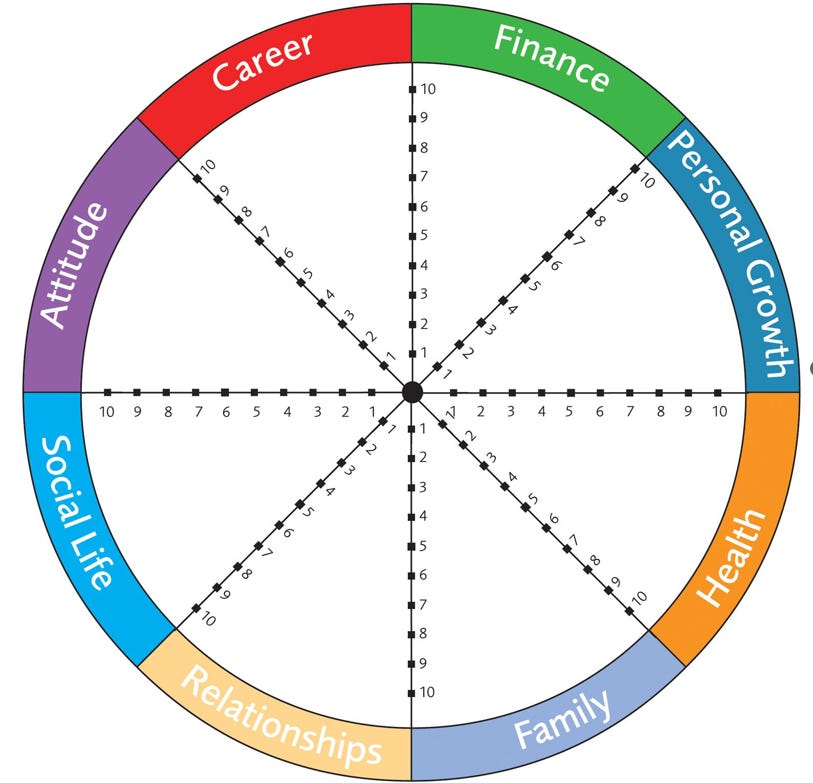
In 2014 at one of our meetup sessions, I was introduced to the wheel of life as a coaching tool. I was hardly able to score myself higher than 3 out of 10 in any of the fields, During covid in 2020 I revisited the wheel, and found in most areas I was scoring 7 or 8s. Life had improved.
The Wheel of Life – Coaching Tool (Nicholls, 2026)
8. To be Young Gifted and Black – Nina Simone 1969
In this whole world, you know,
There are millions of boys and girls,
Who are young, gifted and black
With their souls intact, and that’s a fact.
Key Statistics
- There are millions of talented neurodivergent boys and girls, who are also black or brown, and/or learning in a second language, and /or living in poverty. Neurodivergence is an amplifier of each layer of disadvantage. (Freeman, 2024)
- Neurodivergent people are increasingly recognised at university, in 1995 only 0.42% of students disclosed that they were dyslexic. In 2025 6.8% of students identified as having neurodivergent learning differences (eg. Dyslexia , Dyspraxia, ADHD,) This represents a 14-fold increase. During the same period participation in Higher Education roughly doubled from 30% to 50% (Higher Education Statistic Authority, 2025)
- Dyslexic, Dyspraxic and ADHD graduates, have roughly the same chance of being in employment 3 years after graduating as other students, over 60% Autistic graduates are employed 3 years after graduating while only 25% of the Autistic population have jobs. (House of Commons Library 2021, 2021)
The neurodiversity movement is in part modelled on the American Black Civil Rights movement, in which Nina Simone was an Icon. It is motivated by Self-help to address disadvantage, a desire to fight discrimination and a need to destroy toxicity.
Education is a common battle ground on which both the civil rights movement and the neurodiversity movement have been forced to fight. The Neurodivergent community has needed to fight for the right, to be educated, go to university, and access good quality work. To often education authorities have written off neurodivergent talent and forced ND people to live off poverty wages or benefits.
In my view one of the successes, the Neurodiversity Movement needs to talk about more, is that increasing numbers of ND people are going to university. When I was at university in the early 1980s, I was as far as I knew, the only dyslexic person on the campus. At that time only about 10% of young people participated in Higher Education. In 2025, 50% of young people go to University a fivefold increase since the early 80s , Over the same period neurodivergent participation in higher education has increased by more than 14-fold. Many of the ND people participating in higher education are the first member of their family to attend university and many are drawn from minority communities.
Peculiarly one of the biggest victories achieved by the ND movement, is that more families feel able to fight schools and LEA’s to gain support to which they have a right. In the 60s and 70s, good quality support was only available to a small minority and was principally delivered through fee paying schools. Now a much wider range of families can fight for the right of support. The Sutton Trust, however notes that parents who spend more than £5 000 on challenging an ECHP decision, have a much better chance of success than those who spend less than £5 000 (Sutton Trust , 2026)
Attending University massively increases the employment prospects of ND people. The widening participation in higher education agenda has made a huge difference to the ND community.
These gains are under threat. Fear about student loans, cuts to the disabled student’s allowance, together with, political rhetoric questioning the value of university, puts many gifted ND people off attending university. This stops them accessing the single biggest opportunity to level the playing field and gain good quality work.
My experience of dyslexia was largely lonely middle class, and white. (I was frequently too embarrassed to share my diagnosis). This changed when I started to attend the dyslexic entrepreneurs and professionals meetup group. To start with the group was not remarkable. So much so, that Ruth Ellen Danquah, told us to stop crying into our beer and do something. She did exactly that. She booked google campus and put out a call. 80 people attended. Ruth-Ellen was able to reach a neurodivergent audience I had not previously experienced. She also had a much more practical, understanding of the challenges black, East London, Dyslexics faced.
For ten years I ran the network with Ruth-Ellen. We tried to provide a free, safe, non-judgemental space. A wonderous range of speakers shared their experiences without charging. Early on we identified hot topics which included mental health, self-development, entrepreneurship and creativity. Meetings were not massively structured. We shied away from overt teaching, or employment support.
Through the network I met Marcia Brisset-Bailey who with Ruth-Ellen established the British Dyslexia Association Cultural perspectives committee. This body has played a key role in arguing the need to view neurodiversity through intersectional lenses. Ruth-Ellen, Marcia, Jannette Morgan and Lucita Paul then established the BLEND, Black Leadership in Neurodiversity, network.
Marcia and Jannett are Nina Simone fans. Both took inspiration from her, in writing their books. Black Brilliant and Dyslexic by Marcia Brisset-Bailey. Young Gifted Dyslexic and Black by Jannette Morgan.
9. YaYa - Beyonce 2024
Those pretty ones can’t f..k with me, (why)
Cause I’m a clever girl.
Key Statistics –
- “Women were not the only voices in the struggle for the rights” of neurodivergent (“Dyslexic”) people “but their voices have tended to be” predominant “and crucial.” (Kirby P. , 2018)
- In the 40s and 50s support for Dyslexia was focused on pupils at a small number of privately funded schools eg Millfield , now support for neurodivergent pupils forms the largest proportion of SEND support provided in mainstream schools (Kirby P. , 2018)(Special Needs Jungle , 2003)
- In the 70sit was thought 5 times as many boys than girls were dyslexic (Critchley, 1970). It is now thought that the numbers of neurodivergent males and females are roughly equal and that in the past women and girls were significantly under diagnosed (Lexic, 2026)
- We still have a long way to go. Black Girls are 13 times less likely than white boys to get early neurodiversity diagnosis . (John Innes Centre , 2025) Parents prepared to pay over £5 000 to argue the case for a childs EHCP, have a significantly greater chance of sucess than those who cant afford to do so (Sutton Trust, 2025)
The Neurodiversity movement owes a lot to Lionesses who have fought for their pride. Most of the current leading neurodiversity activists, fighting to change perceptions, widen access to services, and break down stigma, around the world are women. This is not an accident. This is a consequence of women disproportionately taking responsibility for the care and support of a neurodivergent family member. These women have worn boots made for walking, so as to fight, professionals, employers, Education Authorities and Government to get justice for the people they love.
In the 1960s and 70s black women were at the forefront of fighting discrimination in education. When the Inner London Education Authority, decided to send inexplicably high numbers of , African and Caribbean children, to educational sub normal schools. Women activists set up Saturday Schools, to ensure their children got an education. Many of those who benefited were neurodivergent. (BBC, 2020)
Women were the drivers of many of the organisations which built awareness and understanding of dyslexia in the 1970s and eventually forced government to recognise the need of dyslexic learners. (Kirby P. , 2018).
The Neurodiversity movement is unusual, as a civil rights movement. Most civil rights movement are driven by a disadvantaged group fighting for equality. The fight for the rights of dyslexic people which broadened into the, neurodiversity movement, largely originated with privileged families. These families had high expectations for their children. They found their ambitions frustrated by an education system which did not accommodate learning differences. They then felt forced to battle authority so their children recieved a decent education, and given a fair chance to get a good job.
Despite the privileges enjoyed by these families the barriers they faced were real. State education systems institutionally put saving money ahead of educating children who learnt differently. They were happy to write off talent. Families also had to overcome social stigma, within their community. Press accusations that they were using, their privilege to gain unfair advantage . Many professionals they encountered chose to victim blame rather than provide support.
The gains made have rippled out. A far greater number of ND people are now receiving support and being given a better chance to fulfil their potential. This is not exclusively down to activism. Medical understanding of neurodevelopmental conditions has advanced. Autism is no longer, viewed exclusively as being a profound disability as was mostly the case in the 70s. The neurodiversity movement has benefited from victories won by the wider disability movement. In particular the popularising of the social model of disability which draws attention to barriers placed in the way of ND people by society. The traditional model viewed disability in terms of deficits and disadvantage, rather than difference.
Significant progress still needs to be made. While a white neurodivergent boy, with university educated parents is likely to receive early support, and probably experience life with relatively slight disadvantage. This is not the case for all ND children. Black Girls are 13 times less likely to access early diagnosis and support than white boys. (John Innes Centre , 2025) Significant inequalities exist in the SEND system. The Sutton Trust reports parents who spend more than £5000 have a much better chance of getting support than those who cant access that much money.
Neurodivergent young people from disadvantaged communities or from care backgrounds, experience very high rates of school exclusion ,and are disproportionately likely to become NEET, and alarmingly frequently face justice interventions.
We know what works for privileged families. If early screening and intervention occurs It is often not significantly more expensive than funds provided to support a EHCP package. It must therefore be possible to address the institutional inequalities in the neurodiversity jungle.
Bibliography
Almuth McDowall, N. D. (2023). Neurodiversity at Work, Demand Supply and Gap Analysis . Retrieved from Neurodiversity in Business, Birkbeck University : https://eprints.bbk.ac.uk/id/eprint/50834/22/50834c.pdf
BBC. (2020). Small Axe Education . Retrieved from BBC : https://www.bbc.co.uk/programmes/m000qfb1
Critchley, M. (1970). The Dyslexic Child . Wiliam Heinemann.
Freeman, C. (2022). NDnomics 2 – Employment and Unemployment. Retrieved from Substack : https://charlesgjfreeman.substack.com/publish/posts/detail/196631678?referrer=%2Fpublish%2Fposts%2Fpublished
Freeman, C. (2024). Neurodiversity, Equality, Diversity and Inclusion and the Levelling Up Agenda. Retrieved from Achievability E journal : https://www.achieveability.org.uk/files/1675863828/achieveability-3rd-edition-neurodivergent-voices-calling-for-change-from-intersectional-perspectives-2022.pdf
Higher Education Statistic Authority. (2025). Hesa data 1995 and 2025 explored via AI pompt.
House of Commons Library 2021. (2021). Support for disabled. Retrieved from Parliament.UK: https://researchbriefings.files.parliament.uk/documents/CBP-8716/CBP-8716.pdf
John Innes Centre . (2025). Exploring Neurodiversity through an intersectional lens. Retrieved from www.jic.ac.u: https://www.jic.ac.uk/blog/exploring-neurodiversity-through-an-intersectional-lens/
Kirby, A. (2020). Dyspraxia, Developmental Co-ordination disorder . Retrieved from https://www.acamh.org/app/uploads/2021/02/Prof-Amanda-Kirby-slides.pdf
Kirby, A. (2026). Neurodiversity 101:School exclusion: the costs we don’t calculate... Retrieved from Linkedin : https://www.linkedin.com/pulse/neurodiversity-101school-exclusion-costs-we-dont-prof-amanda-yzzqf/
Kirby, P. (2018). A brief History of Dyslexia . Retrieved from The Psychologist : https://www.bps.org.uk/psychologist/brief-history-dyslexia
Lexic. (2026). The link between neurodiversity and gender. Retrieved from https://lexxic.com/blog/the-link-between-neurodiversity-and-gender
Mullally, D. S. (2024). Children at the frontline — neurodivergence and school distress. Retrieved from Research Futures : https://researchfeatures.com/children-frontline-neurodivergence-school-distress/
Nicholls, K. (2026). Wheel of life tool. Retrieved from Life Coach Directory : https://www.lifecoach-directory.org.uk/content/wheel-of-life-tool.html
SCOPE. (2019). Life costs more for disabled children and their families. Retrieved from Scope : https://www.scope.org.uk/news-and-stories/life-costs-more-for-disabled-children-and-their-families
Sinead L Mullaly, S. E. (2025). I Felt shamed and blamed: an exploration of the parental lived experience of school distress. . Retrieved from Frontiers in Psychiatry: https://www.frontiersin.org/journals/psychiatry/articles/10.3389/fpsyt.2025.1489316/full
Special Needs Jungle . (2003). SEND 2023: Numbers increase, and is SEN (No idea what type) the new Moderate Learning Difficulties? Retrieved from Special Needs Jungle : https://www.specialneedsjungle.com/send-2023-numbers-increase-sen-no-idea-what-type-new-moderate-learning-difficulties/
Universal Music . (2020). Creative Difference . Retrieved from https://umusic.co.uk/Creative-Differences-Handbook.pdf